A single bulb on the ceiling exhausts the room. Three sources, at three heights, for three uses, and the very same volume changes face. A practical guide, by height, by intensity, by warmth.
Why three.
A lone ceiling fixture flattens a room. It draws shadows under the eyes, levels the volumes, hardens the corners. No home tolerates that single light for long. Yet that is what one almost always inherits from a developer hand-over: one central point, a warm or cool bulb depending on luck, and nothing else. Everything else has to be invented.
The rule, inherited from the Scandinavian architects, fits in one sentence. A room needs three sources of light, at three distinct heights, for three different uses. Ceiling, wall, table. Ambient, grazing, functional. That is the minimal backbone of a lighting plan that holds together.
Source 1, the ambient.
This is the high source. Pendant, ceiling fixture, recessed spot or technical track. Its function is utilitarian, not decorative: it allows you to move around, to find a key on the floor, to run the vacuum. It stays off eighty percent of the time, as soon as the room is being lived in.
The most frequent mistake is to oversize it. A good ambient light is diffuse, rather indirect, and always on a dimmer. A spot bouncing off a pale wall, a pendant with an opaque shade, an LED strip tucked into a cornice: anything that rebounds before reaching the eye is worth more than a bare bulb.
Source 2, the grazing.
This is the mid-height source, drawing the walls. Sconce, floor lamp with directed diffuser, swing-arm wall light, strip hidden behind a low cornice. Its function is not to light so you can see: it is to light so as to give depth, to reveal the texture of a plaster, of a wood panel, of a moulding.
This source changes everything in a deep room, in a corridor, in a living room with blind corners. It opens up the volume. It cancels the shadow zones that make a room feel smaller than it is. More than anything else, it is what separates an ordinary interior from a designed one.
"The right number of sources is three. Beyond that, you patch. Below, you suffer."
Source 3, the functional.
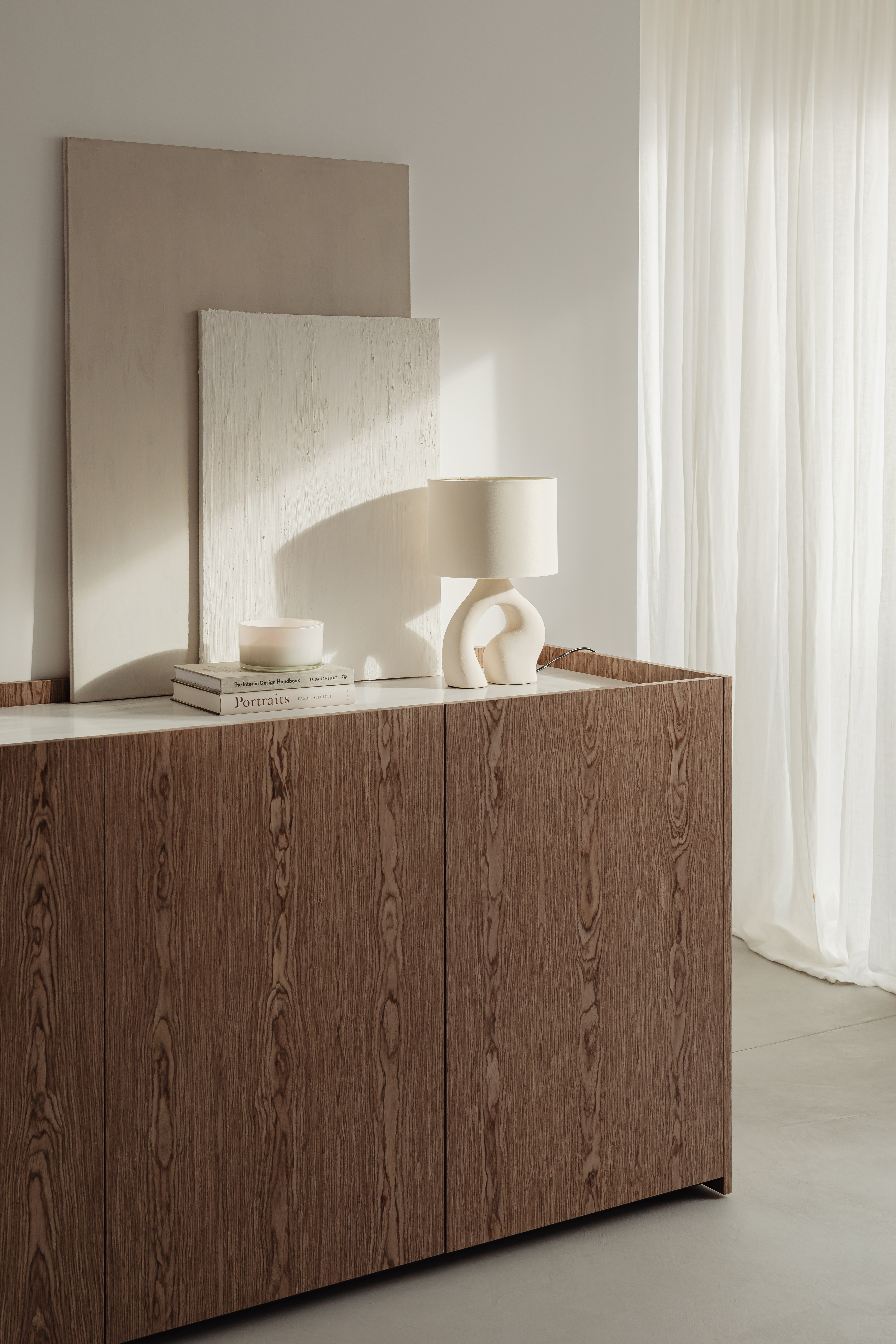
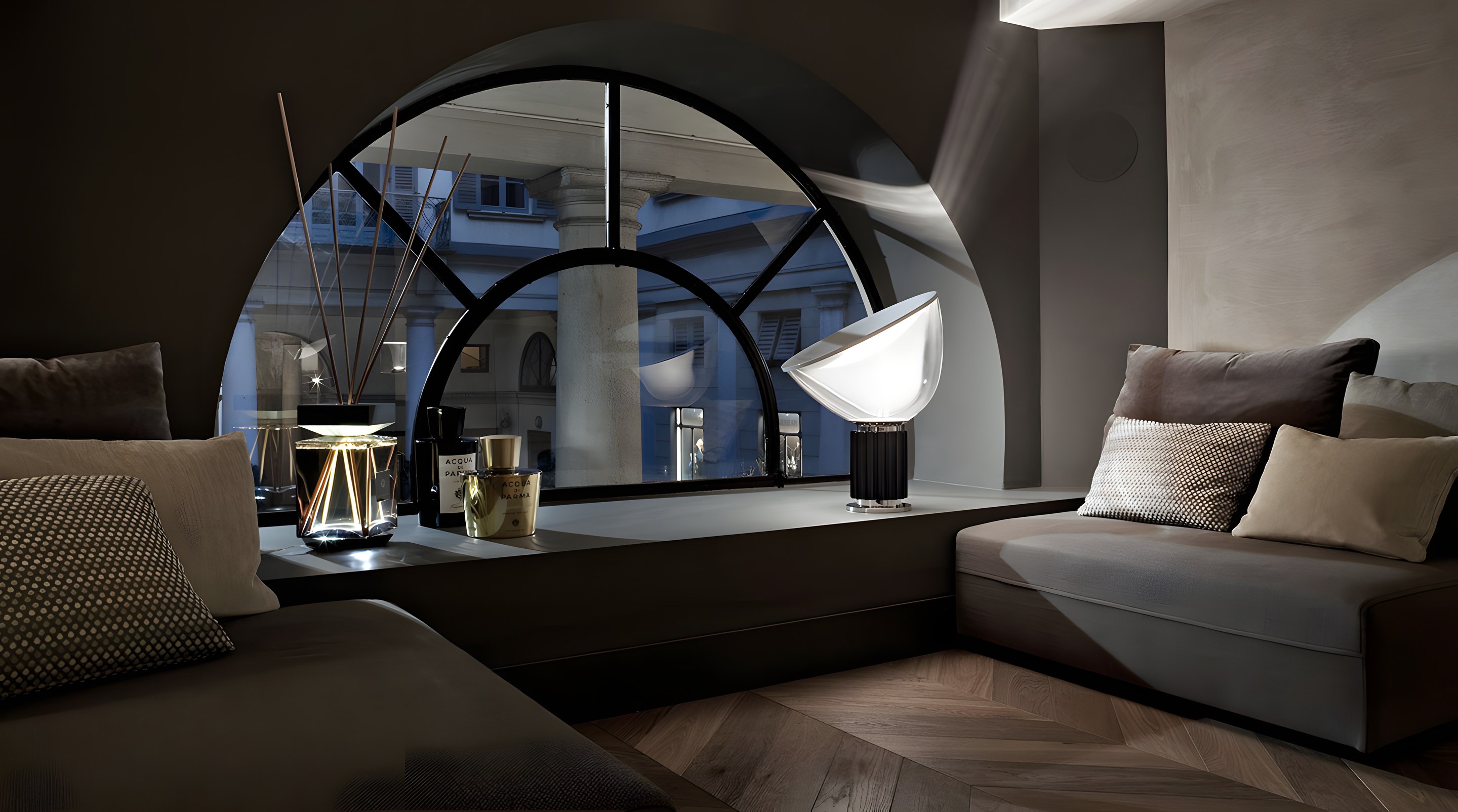
This is the low, set-down source. Table lamp, bedside lamp, pendant dropped over the kitchen island, clip-on reading light. Its function is precise: to read, to dine, to work, to put on make-up. It is directional. It is warm. It sits, almost always, at eye level or below.
It is the most neglected source in French interiors. One inherits a ceiling fixture, sometimes adds a sconce, but the table lamp on the sideboard, the reading light beside the armchair, the pendant lowered to seventy centimetres above the dining table — those, one forgets. And yet that is the source that makes a room liveable in the evening.
The 2700-kelvin rule.
All artificial light is measured in kelvins. Below 3000 K, the light is warm, golden, alive. Above 4000 K, it is cold, white, clinical. At home, outside the kitchen and the bathroom, everything should sit at 2700 K. Not 3000. Not 3500. 2700. It is the temperature of a candle, of a fireplace, of late-afternoon light. Anything else feels aggressive after ten in the evening.
The other figure to watch is the colour rendering index, the CRI. Below 90, light distorts materials: it yellows whites, dulls walnut, kills the glow of brass. Above 90, the colours return. A good decorative bulb should always be CRI 90 or higher, even if it costs three euros more per piece.
Everything on a dimmer.
Every source, without exception, should be dimmable. That is the condition for a room to cross the whole day. At nine in the morning, you want a clean light. At ten in the evening, you want firelight. That is not the same setting. Nor, for that matter, the same sources lit.
On every new installation we prescribe dimmer modules on each circuit as a matter of course, and we leave the functional sources on outlets controlled by a wall switch. So that, on entering the room, you choose not to switch on the ceiling fixture but to choose a scene: table lamps alone, then sconces, then ceiling only as a last resort.
One room, three scenes.
Take an ordinary 25-square-metre living room. Three scenes are enough to make it liveable from morning to night.
- Work, daytime: ceiling fixture on dimmer at 70 %, sconces off, desk lamp on. Clean light, no parasitic shadows.
- Reading, late day: ceiling off, wall sconce at 40 %, reading light beside the armchair at 80 %. Directional light, soft on the sides, bright on the page.
- Dinner, evening: ceiling off, sconce at 30 %, table lamp on the sideboard at 60 %, pendant above the table at 50 %. Four points of warm light, no ceiling. The room becomes theatrical.
What we never do.
Four mistakes come back in every interior we redo. The first: recessed spots set out in a grid across the whole ceiling, the so-called "starry sky", which turns the room into an open-plan office. The second: a central ceiling fixture without a dimmer, on permanently. The third: a single overly powerful bulb, at 2700 K but 1500 lumens, doing duty as everything, lighting nothing properly and exhausting the eye. The fourth: different colour temperatures on the same floor — warm white in the living room, neutral in the corridor, cold in the kitchen. The brain stumbles at every threshold. The home looks patched together.
The rule of three sources, on its own, sorts out those four mistakes. Once set, you don't go back.
Three sources, three heights, three uses. All at 2700 K, all at CRI 90, all on a dimmer. Ceiling fixture as a last resort, table lamp as a first move. And, for rooms already wired up, a single extra sideboard lamp is enough to change everything.