In a courtyard off rue Saint-Guillaume, beneath a building no one would agree to demolish, hides one of the most beautiful modern houses in the world. A visit to a manifesto of interior architecture, glass block by glass block.
A thwarted commission.
In 1927, Doctor Jean Dalsace and his wife Annie bought an eighteenth-century town house at 31 rue Saint-Guillaume, in the 7th arrondissement. The idea was simple: demolish the building, raise a modern house in its place. The couple entrusted the project to a decorator still little known to the wider public, Pierre Chareau.
But an elderly tenant on the top floor refused to leave. Her lease protected her. Demolition became impossible. Chareau, rather than abandoning the project, proposed something extraordinary: keep the upper storey exactly as it stood, shore it up, and slide a new house beneath the foundations. Three complete levels, in the heart of the city, under an inhabited building. No one, at the time, had ever attempted such a feat.
The wall of glass blocks.
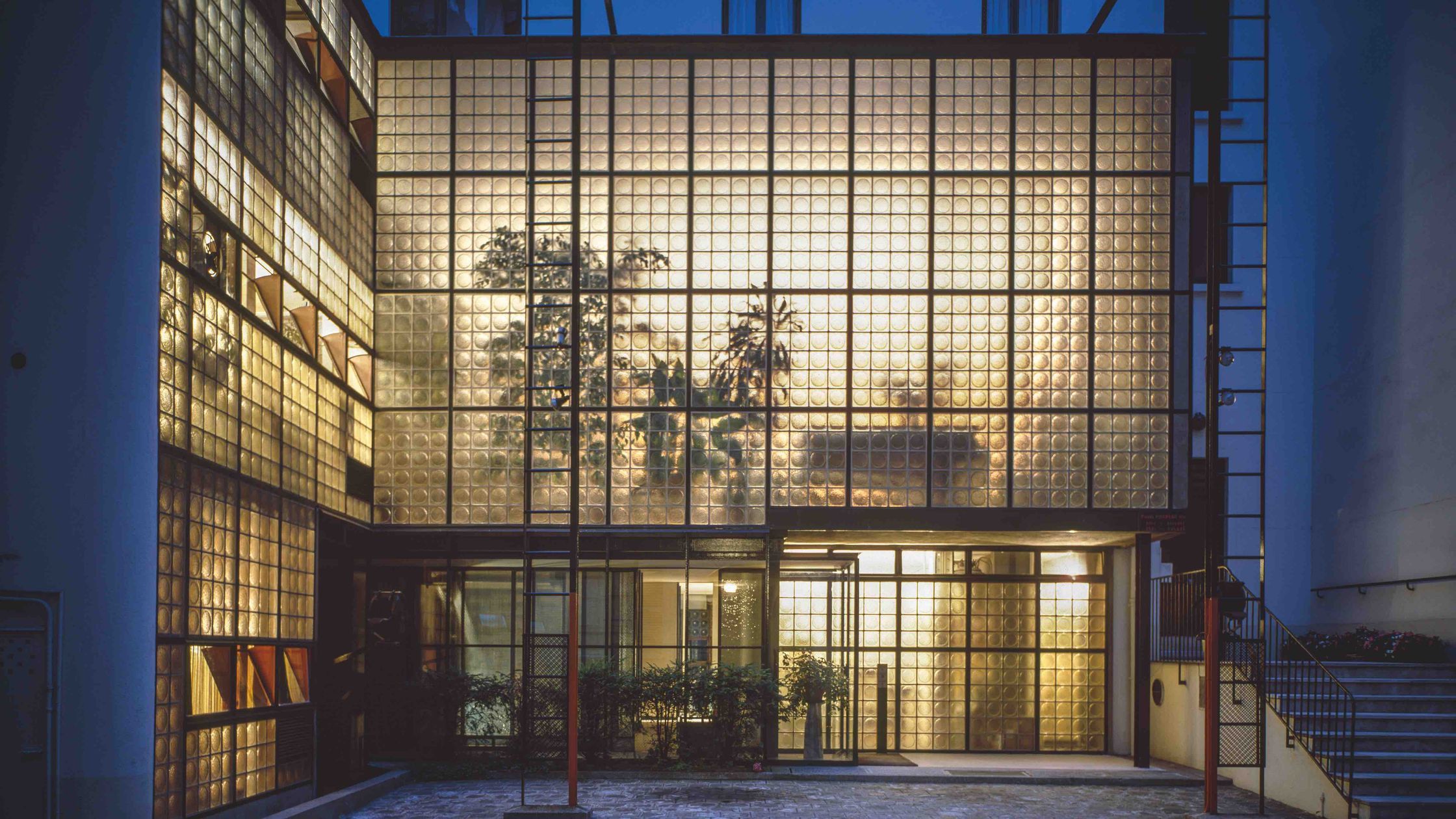
To solve the question of light, the courtyard being so narrow and the neighbours so close, Chareau invented an entire facade made of Nevada glass blocks, manufactured by Saint-Gobain. Four hundred four-faced blocks, aligned across three storeys. By day, they diffuse a milky, directionless light. By night, the facade glows like a muffled lantern, revealing nothing of what lies inside.
No one, before the Maison de Verre, had thought to turn a whole wall into a filter for light. The technique would become, decades later, a classic of contemporary architecture. But Chareau invented it here, in 1928, to solve a very concrete problem: to let the light in without letting the gaze follow.
"A house that hides and illuminates at the same time. That is the brief."
The absolute bespoke.
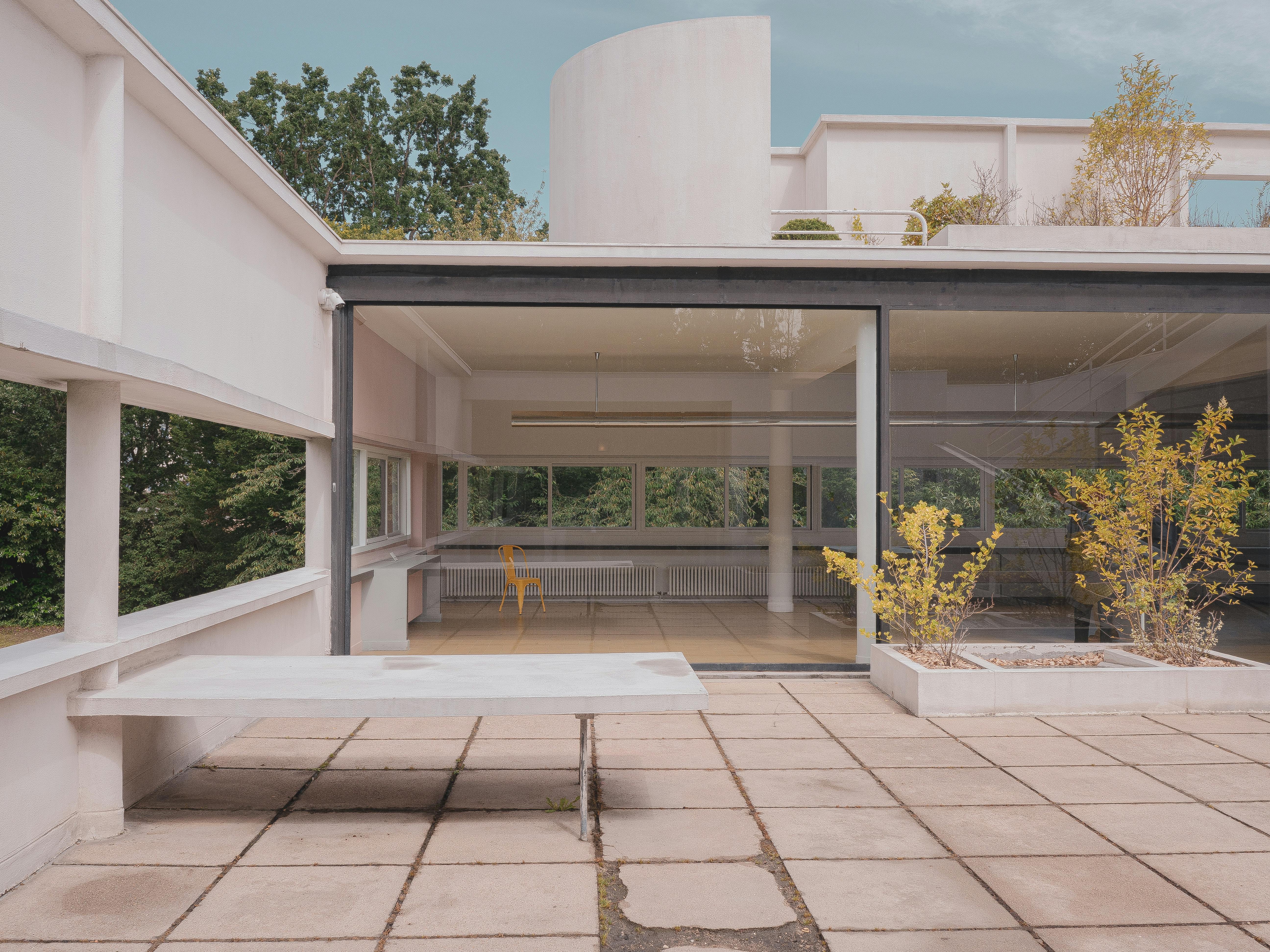
Everything, at the Maison de Verre, is drawn. The handles, the staircase rails, the hinges, the taps, the light fittings, the furniture, the partitions. Chareau hardly placed a thing he had not designed himself. Where the Villa Savoye is content to impose a form, the Maison de Verre invents, at every scale, a language of the interior.
Staircases fold away to free a passage. A partition slides and turns a bedroom into a study. A bookcase pivots to open a corridor. The house never reveals itself all at once. It unfolds, folds back, reconfigures itself according to the hour and the use.
A dialogue with the craftsmen.
Chareau did not work alone. Beside him stood the Dutch architect Bernard Bijvoet, who handled the structure, and above all Louis Dalbet, a Parisian art metalworker, who executed almost every detail in steel. The rivets were left exposed, the steel profiles kept raw, painted black. The industrial became ornament.
This is, perhaps, the most lasting lesson of the Maison de Verre. It is not the work of a single architect, but of a trio, in which the craftsman holds his place as an equal. No detail was bought from a catalogue. Everything was thought through, drawn, forged. That posture, grown rare again in the twentieth century, remains for us a model.
The factory turned intimate.
Riveted steel, industrial glass blocks, metal grating underfoot, lamps with their mechanism in plain view: the Maison de Verre borrows its whole vocabulary from the early-twentieth-century factory. And yet, one lives in it. One sleeps there. One receives there. The great central room, full of double height, serves as a sitting room, a music room, a waiting room when Doctor Dalsace consulted his patients on the ground floor.
That tension, between an industrial vocabulary and a domestic function, is the most precious invention of the house. Before it, industry was ugly and the domestic was ornate. Chareau showed that one can inhabit a frame of steel as one would inhabit a silk-lined drawing room. It is enough to draw every piece, down to the very last screw.
Why visit it.
The Maison de Verre is not a museum. It remained inhabited until the early 2000s, then passed into the hands of an American collector who now ensures its conservation. One does not wander through it freely. The visits are rare, by appointment, in small groups, always guided. But they exist.
The experience is worth the journey. No photograph restores the quality of that light through the blocks, nor the soft sound of a partition being slid into place, nor the precision of a handle conceived for a single hand. The Maison de Verre is to be lived. It is, to our eyes, the most important house of the twentieth century for anyone who cares about interior architecture.
Maison de Verre, 31 rue Saint-Guillaume, 75007 Paris. Private visits by appointment only, in French or in English, in restricted groups. Bookings through the managing foundation; several months of waiting should be expected.