Charles-Édouard Jeanneret-Gris, known as Le Corbusier (1887–1965), did not only transform the architecture of the twentieth century. He redrew the very way we inhabit. Portrait of a visionary who continues to divide as much as he inspires.
From La Chaux-de-Fonds to Paris.
Born in 1887 in the Swiss Jura, trained at the art school of his native town under Charles L'Eplattenier, Charles-Édouard Jeanneret formed himself by practice: in the workshops of Auguste Perret in Paris, of Peter Behrens in Berlin. He travelled widely. Italy, Greece, Turkey, the East. The Parthenon was for him a revelation. He drew compulsively. He took notes.
In 1917, he settled definitively in Paris. He began to sign as Le Corbusier from 1920, choosing a surname half-inherited from a great-uncle, half-invented. A way of marking a rupture: he would no longer be one architect among others.
The manifesto of 1923.
At thirty-six, he published “Towards an Architecture.” A short, striking book, illustrated with ocean liners, cars, aeroplanes. His thesis: the house is no longer a monument. It is a machine for living in. Function takes precedence over ornament. Light, circulation, air are the true materials of the twentieth century.
The book was a shock. Some saw in it a liberation, others a betrayal. Within a few years, he had become the most discussed architect in Europe.
“Architecture is the establishing, with raw materials, of moving relationships.”
The Five Points.
In 1927, he formulated his “Five Points of a New Architecture”:
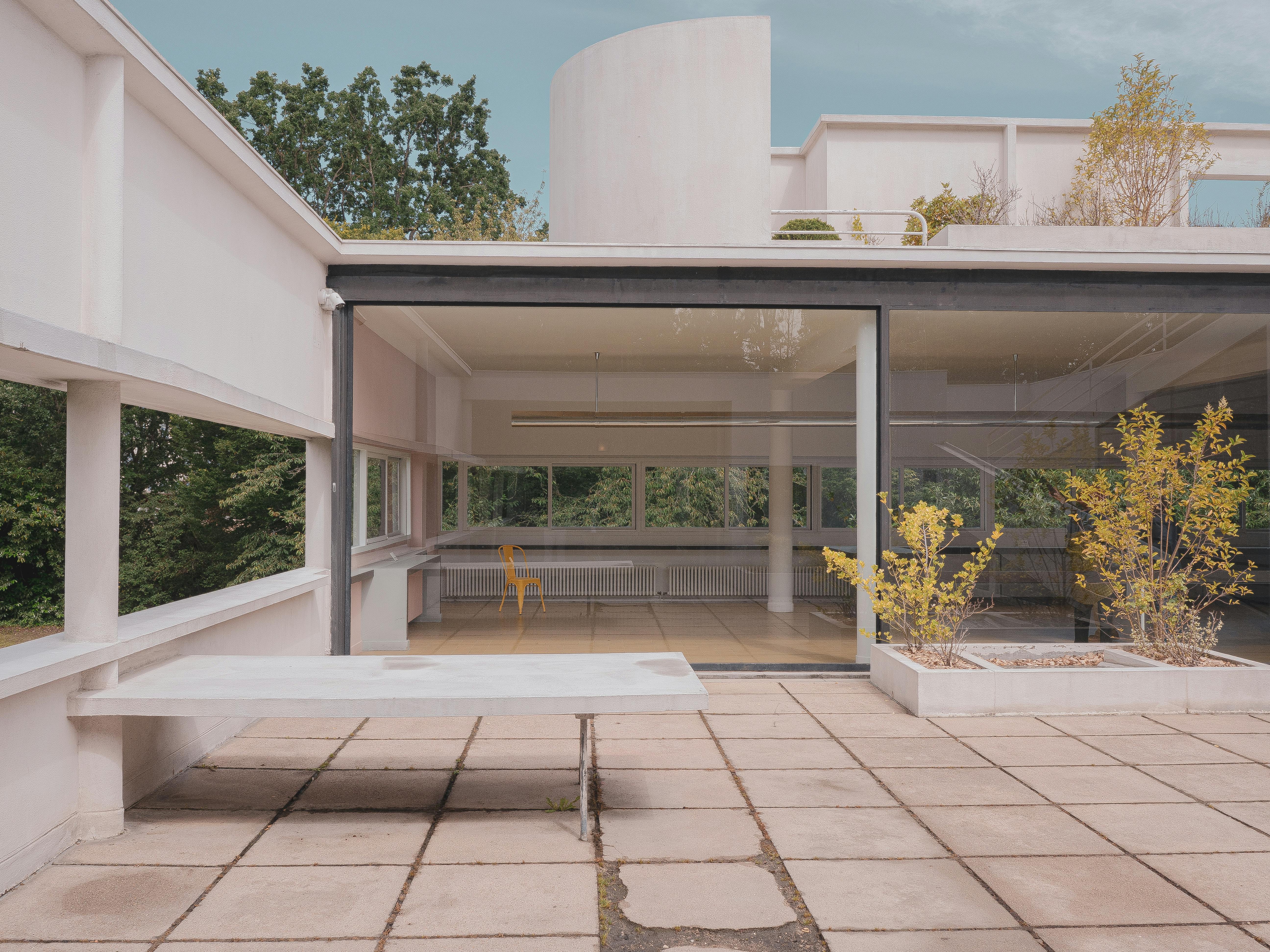
- Pilotis, which free the ground and open it to circulation.
- The free plan, made possible by the column-and-slab structure, which releases the interior layout from the constraints of the load-bearing wall.
- The free facade, a consequence of the free plan: the facade is no longer structural, it can do anything.
- The ribbon window, which runs the entire length of the facade and redefines the relation to the landscape.
- The roof terrace, which gives back to the building the ground surface it has taken.
These five principles, applied at the Villa Savoye in 1931, became the grammar of much of modern architecture.
The Modulor.
In the 1940s, Le Corbusier invented the Modulor, a system of measurements based on the proportions of the human body, a man of 1.83 m, arm raised. He saw in it a universal tool for reconciling standardised industry with the human scale.
The Modulor was used in all his subsequent projects, from the Cité Radieuse to Chandigarh. Controversial, still debated, it bears witness to one obsession: that architecture, even industrial, should remain to the measure of the one who inhabits it.
The urbanist.
Le Corbusier did not think only of the house. He thought of the city. Plan Voisin for Paris (1925), which proposed, terrifyingly, to raze part of the Marais and erect towers on the site. The Cité Radieuse in Marseille (1947–1952), a building of 337 dwellings conceived as a “unit of habitation,” a vertical city.
And above all, Chandigarh (1951–1965), in India: a state commission, an entire city to design, the capital of Punjab. There, Le Corbusier deployed the whole of his urbanist thinking: zoning, separation of flows, monumentality of the Capitol. A utopia that marked world urbanism, for better and for worse.
A divided legacy.
Adored, contested, the work of Le Corbusier was inscribed on the UNESCO World Heritage List in 2016, seventeen sites in seven countries. No architect has marked the twentieth century more deeply. None has been so thoroughly questioned: he is reproached for his sometimes inhuman urbanism, his troubling political sympathies in the 1930s, his problematic relationship with Eileen Gray.
But his ideas have prevailed. The free plan, the ribbon window, the roof terrace, the opening of the living room onto the outside: today, this is the obvious. A century ago, it was a revolution.
Why read him again.
To love or not to love Le Corbusier is secondary. To understand him is obligatory for anyone interested in inhabited space. He posed the questions we are still asking today: what is a house for? How does light enter? How do we move through it? How do we connect inside and outside?
Every contemporary project, whether it claims him or opposes him, is still in dialogue with him. That, perhaps, is the very definition of a classic.