At Poissy, a white villa raised on its pilotis since 1931 sums up, on its own, the architectural revolution of the twentieth century. A guided visit to a manifesto turned myth.
An almost ordinary commission.
In 1928, the Savoye couple, a Parisian banker and his wife, asked Le Corbusier for a second home some thirty kilometres from Paris. The brief was simple: a country house for the weekends. The architect saw something else in it: the chance to put into practice, at full scale, his “Five Points of a New Architecture,” published a year earlier.
When the villa was delivered in 1931, the couple moved in with a certain perplexity. The house leaked, the radiators were not enough, the roof terrace turned into a swimming pool when it rained. But something had happened. Modern architecture had just been born.
The effect of subtraction.
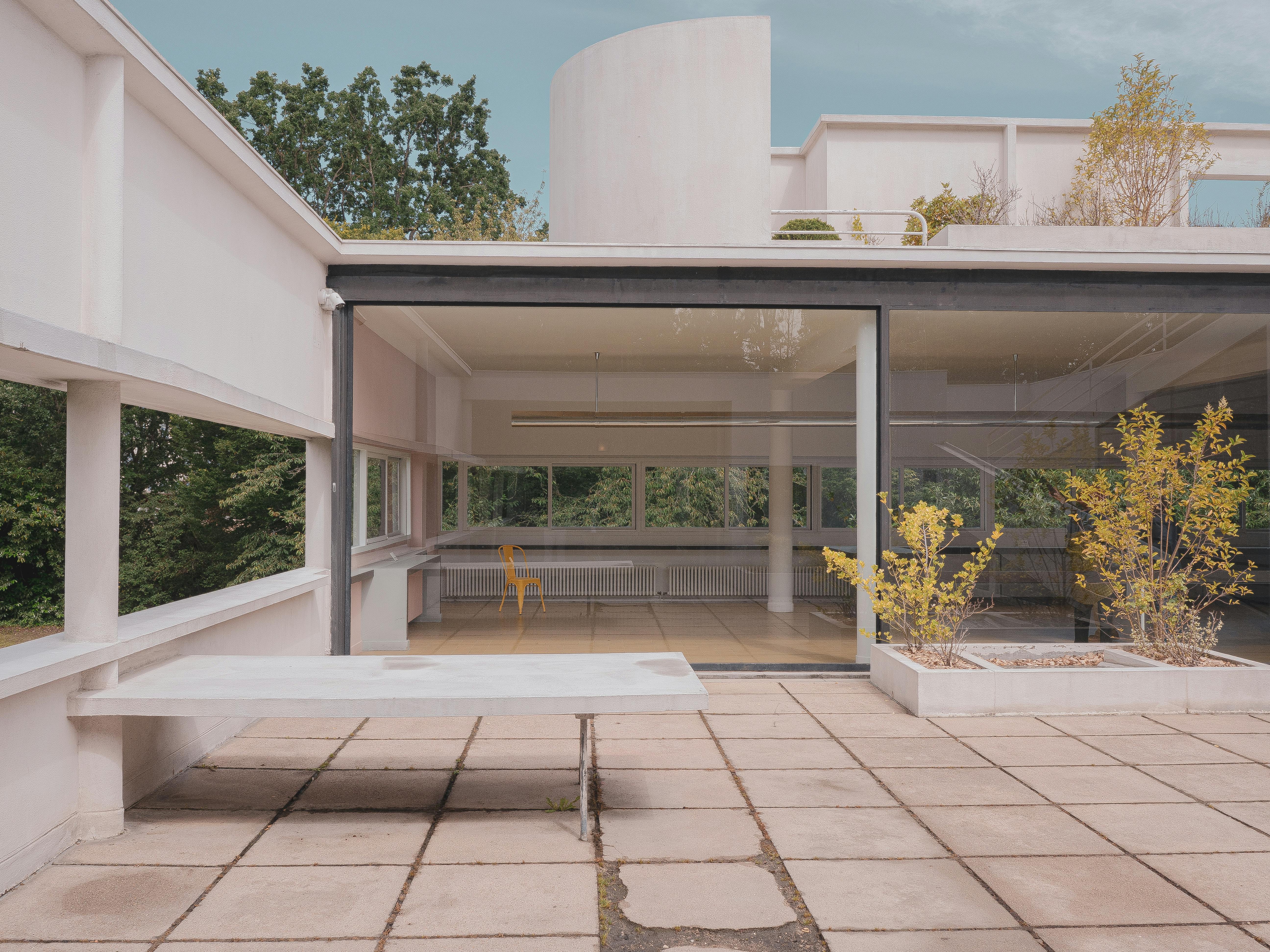
When you arrive in front of the Villa Savoye, what strikes you is not the mass, it is the void. The house floats. The pilotis free the ground, turn the car into an element of the threshold: the curve of the driveway is calculated on the turning radius of a Citroën of the period.
It is one of the first houses conceived for the automobile. Not as an accessory, but as an actor in the ritual of arrival. You arrive by car, you park beneath the house, you climb the ramp, the house begins before any door has been pushed open.
“The house is a machine for living in. But above all, it is a promenade.”
The interior rite.
Entry is made beneath the villa. A gentle ramp, parallel to a spiral staircase, links the levels. Le Corbusier called this the “architectural promenade”: a passage that prolongs the outdoor walk, that turns the crossing of the house into one continuous experience.
On the first floor, the living room opens onto the terrace-garden. The ribbon window runs the full length of the facade: for the first time, the room looks at the landscape in panorama, without vertical interruption. The distinction between inside and outside fades.
Light as material.
Horizontal ribbons replace traditional windows. Light enters in calibrated slices, structures the space, sculpts the volumes. The roof terrace, solarium, hanging garden, observatory of the sky, closes the promenade from above.
The villa is white outside, white inside. This whiteness is not neutral: it is the screen on which daylight becomes legible. Each hour, the villa changes face. That is, perhaps, its best-kept secret.
The immediate legacy.
The Villa Savoye defines the modernist language for the decades to come. Pilotis. Free plan. Free facade. Ribbon window. Roof terrace. These five points become the grammar of much of twentieth-century architecture.
In 1965, the villa, abandoned and in an advanced state of dereliction, escaped demolition thanks to an international mobilisation. Restored, listed as a historic monument, inscribed on the UNESCO World Heritage List in 2016, it remains one of the most visited buildings in the world by architects and design enthusiasts.
Why visit it.
No image replaces the experience of the ramp. No photograph restores the light gliding over the white walls through the course of the day. The Villa Savoye is lived by walking, by climbing, by lingering on the terrace. An hour is enough. The effect, however, lasts a great deal longer.
Villa Savoye, 82 rue de Villiers, 78300 Poissy. Open every day except Monday. Access from Paris via RER A towards Cergy or Poissy, then bus 50 or a 15-minute walk.