She has long been reduced to three armchairs of bent steel. Charlotte Perriand was far more than that: the warm conscience of modernism, the woman who brought wood, light and the hand of the maker back into a century tempted by the machine alone.
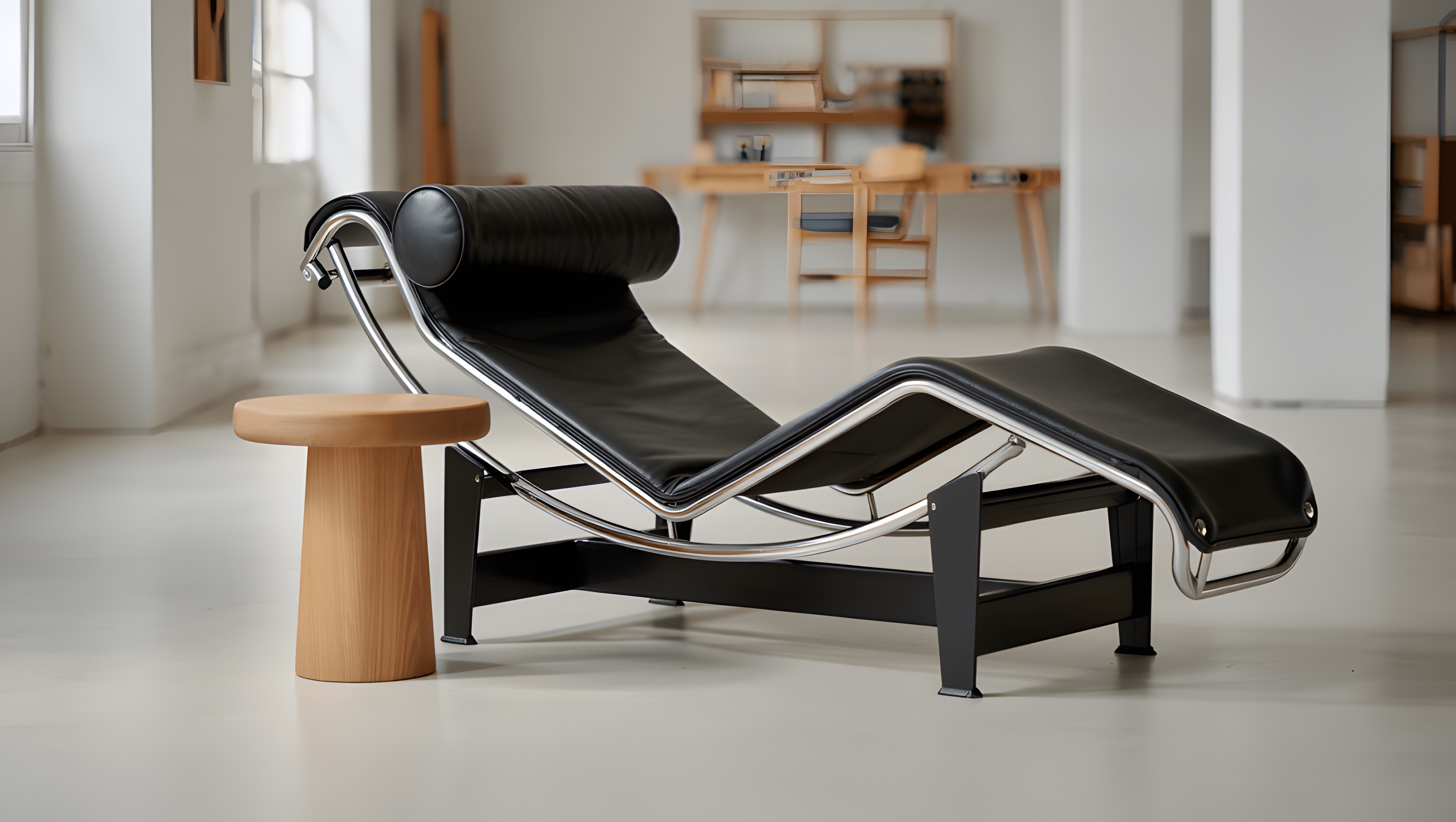
There are, in the history of design, names one cites without always knowing what they really cover. Charlotte Perriand's is one of them. She is forever associated with the leather-and-chrome chaise longue, by now a logo for any interior that wishes to call itself modern. We forget that the woman who drew it spent the rest of her very long life turning her back on that image, fleeing the cold of metal for the warmth of wood, and inventing, piece by piece, what she simply called the art of living.
A young woman and a studio.
1927. Charlotte Perriand is twenty-four years old. At the Salon d'Automne she exhibits a Bar sous le toit, an attic bar in anodised aluminium, nickel and glass — a precise, cold-edged corner of modernity that stands out against the bourgeois decor of the day. The press notices the young woman who draws like an engineer. Buoyed by that success, she walks up to Le Corbusier's studio, rue de Sèvres, to offer her services.
The master, the legend goes, turns her away with a single famous line: "We don't embroider cushions here." A few weeks later, he visits her Bar sous le toit at the Salon, realises his mistake, and calls her back. She enters the studio to take charge of the whole "equipment of the dwelling" — meaning the furniture, the object, the daily contact between body and house. She would stay for ten years.
Metal first, then wood.
Out of that decade come the pieces that would travel the world. In 1928, with Le Corbusier and his cousin Pierre Jeanneret, Charlotte Perriand designs the tilting chaise longue, the Grand Confort armchair, the low-backed swivel chair. Bent steel tube, leather, pony hide: a manifesto of the seated position rethought through geometry. History has often credited those pieces to Le Corbusier alone. Yet they owe what makes them right — the angle of a seat, the curve of a headrest — to Perriand's hand and eye.
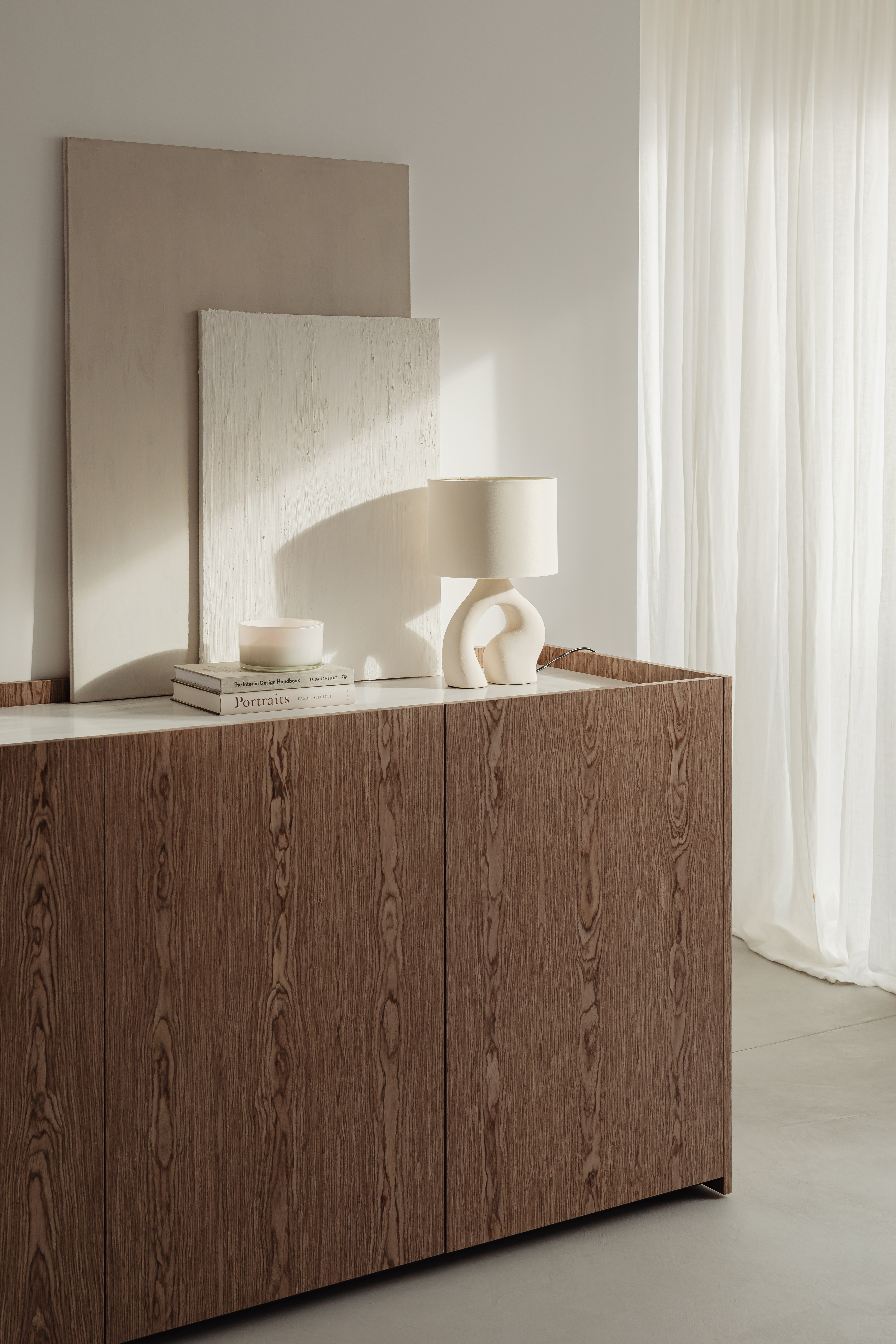
But metal would not keep her. By the late 1930s she leaves the studio and makes a turn her own era did not understand: she returns to wood, to stone, to fibre, to the free forms drawn from a pebble or a bone picked up on a beach. Where orthodox modernism saw nature as a disorder to be corrected, she read in it a repertoire of shapes and warmths. Her solid wood free-form table, without a single right angle, is a quiet reply to the tyranny of the line.
"Modernism never had to be cold. It only needed someone to give it back its hand, its material, its light."
The journey to Japan.
In 1940, invited as an industrial-design adviser to the Japanese Ministry of Commerce, she crosses a world at war to reach Tokyo. The shock is foundational. She discovers a culture in which raw material, emptiness, diffuse light and the gesture of the craftsman have composed for centuries an art of living of staggering modernity. Her 1941 exhibition, Selection, Tradition, Creation, sets her own furniture against the Japanese mastery of bamboo and wood.
The war then keeps her in Indochina for several years, where she learns weaving, rattan, the working of plant fibres. When she comes back to France in 1946, she is no longer quite the same: Parisian functionalism has been washed by Asia, made supple, made warm. That mixing would become her signature.
The mountain, Les Arcs.
The post-war years see her in dialogue with the greats — Jean Prouvé, for whom she designs the Nuage bookcase with its colour-blocked compartments; Fernand Léger; the Steph Simon gallery that distributes her pieces. But her great work is not a piece of furniture. It is a mountain. From 1967 to the late 1980s, she designs the ski resort of Les Arcs, in Savoie, and deploys there a total thinking of mass housing.
Hundreds of apartments are equipped according to her principles: prefabricated kitchens cast in a single piece, moulded bathrooms, integrated storage, picture windows framing snow and sky. Luxury here lies not in marble but in precision: every centimetre considers use, every volume catches the high-altitude light. It is the culmination of a whole life spent believing that good living is not reserved for the wealthy.
The art of living.
Charlotte Perriand dies in 1999, at ninety-six, after crossing almost the entire century she helped draw. Her Maison au bord de l'eau, a 1934 project long left on paper, would be built in 2013; a major retrospective would do her justice in 2019. The world then rediscovered what she had always known: that she never had been the assistant of a great man, but a creator in her own right.
What she leaves us goes well beyond furniture. It is a way of asking the right question before any room: not "is it beautiful?", but "how does one live in it?". Does the light come in well? Will the wood age gracefully? Does the body find its place? In every one of our own designs, it is still her lesson we follow: bringing nature and warmth into spaces where one expected only floor plans.
Perriand proved that a modern interior can be warm. Three lessons still hold. Prefer wood and stone over smooth finishes. Draw use and the movement of the body first. Frame natural light as one would frame a painting. The rest, she would have said in essence, is just decor.