A stone born of water, riddled with cavities, warm as a loaf of bread. In 2026, travertine returns to the front of pared-down interiors. Here is why we choose it, and how to use it without betraying it.
A stone born of water.
Travertine is not a marble. It is a sedimentary limestone, formed slowly by the deposit of calcium carbonate around hot springs and mineral-laden waters. The gas bubbles trapped during this formation leave those small cavities that are its signature: a surface that seems to breathe, never quite smooth, never quite sealed.
The Romans were already quarrying it at Tivoli, ancient Tibur, which gave the stone its name, lapis tiburtinus. The Colosseum is built of it, as is Bernini's colonnade on Saint Peter's Square. A material that lasts two thousand years has nothing left to prove about endurance.
The meaning of the cavities.
The whole question of travertine lies in the treatment of its pores. You can leave them open, and the stone keeps its raw, tactile, almost archaeological grain. You can fill them with resin or tinted putty, and you obtain a continuous surface, easier to live with, more contemporary. Neither is better: it is a decision of character.
Then comes the finish. Honed, the stone stays matte and velvety, which is our preference; it absorbs light rather than throwing it back. Polished, it gains brilliance but loses that softness that makes its whole value. Travertine does not like to shine.
"Travertine does not decorate a room. It gives it a geological memory."
Why now.
The 2026 decorative year puts material back at the centre: we look for surfaces to touch, honest textures, a minimalism that warms rather than cools. Travertine ticks every box. Its palette of beiges, ivories and hazelnut tempers neutral interiors without weighing them down; its porosity brings relief where marble, too smooth, remains distant.
It is also a response to biophilic design: a stone that says explicitly where it comes from, and ages by gaining a patina rather than by deteriorating.
How to use it well.
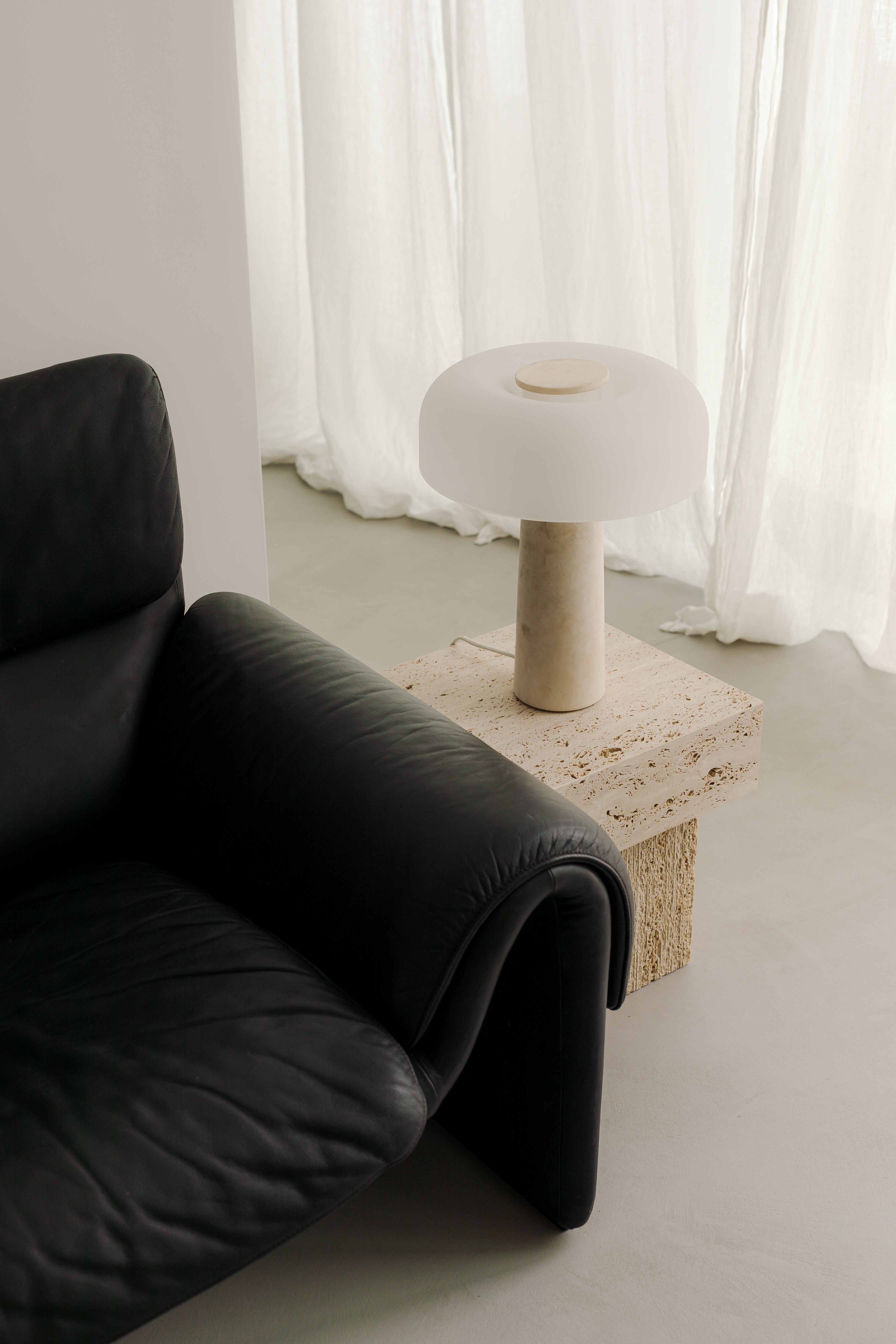
Travertine reveals itself in sculptural pieces more than in vast surfaces. A monolithic coffee table, a vanity top, a generous skirting, a lamp base, a fireplace mantel: those are its right scales. As a honed and filled backsplash, it holds up perfectly. As flooring, it is sublime in an entrance hall or a wet room, provided one accepts its patina.
The pairings that work.
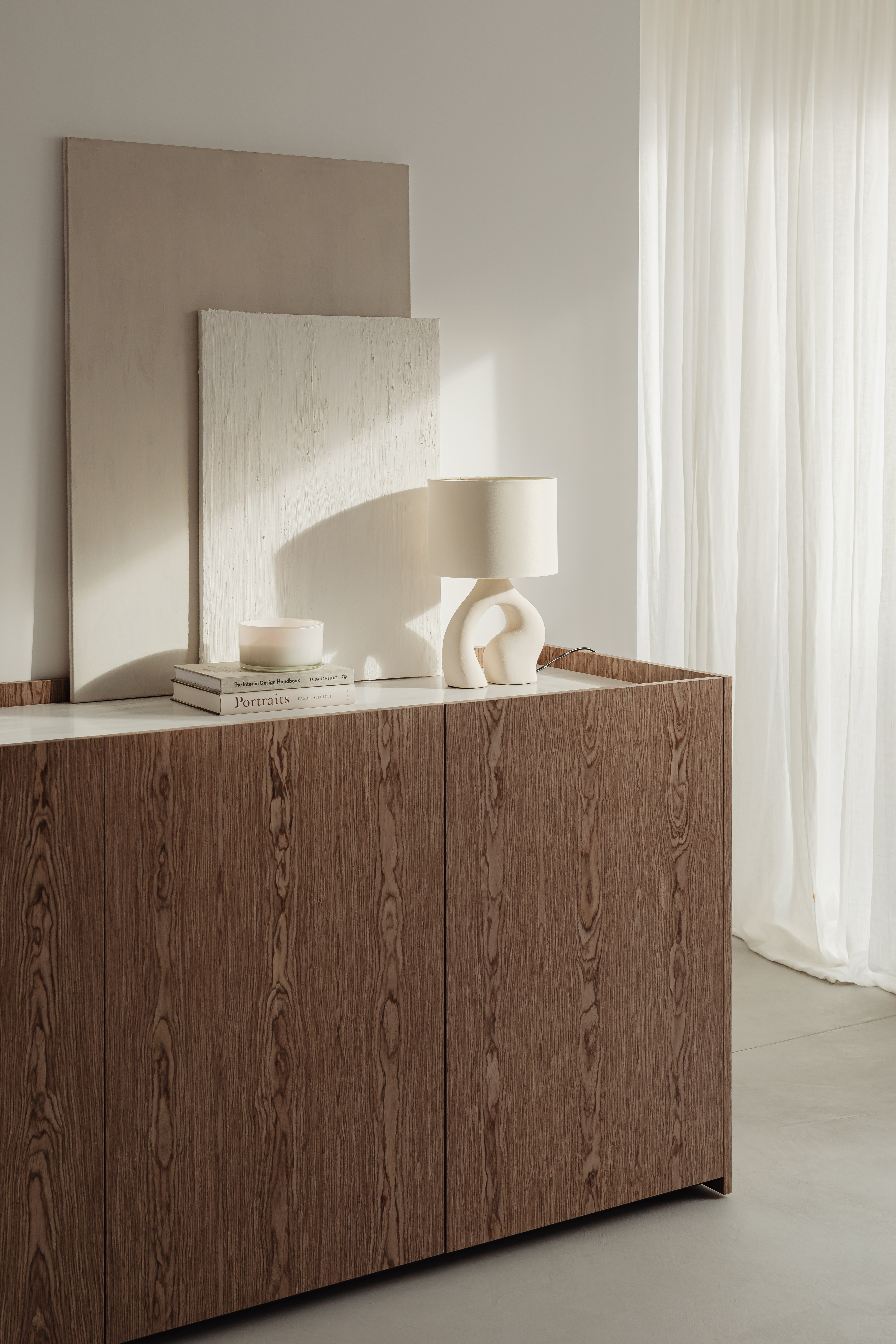
- With smoked walnut: porous stone and dense wood answer each other, the eye slides from one to the other without shock.
- With unbleached linen or waxed plaster: same family of matte materials, the room becomes an echo chamber of beiges.
- With patinated brass: a single touch of warm metal is enough to wake the stone up.
- With black leather: the safest contrast, the dark depth makes every cavity stand out.
The mistakes to avoid.
- Do not lay it raw on a kitchen worktop: lemon, vinegar and wine mark limestone for life. A kitchen travertine should be filled, honed and protected.
- Do not choose a mirror-polish finish: it loses its reason to exist and imitates marble poorly.
- Do not saturate the room: two surfaces of travertine dialogue, five become a crypt.
- Do not neglect water-repellent impregnation: an untreated porous stone drinks everything you spill on it.
A material that remembers.
Travertine is not bought for the effect of the moment. It is bought because one accepts that a stone may live, gain its patina, keep the trace of a glass set down on a summer evening. In twenty years, it will have the same warmth, a little more memory. That is exactly what we ask of a material: to accompany a house without ever asking to leave it.