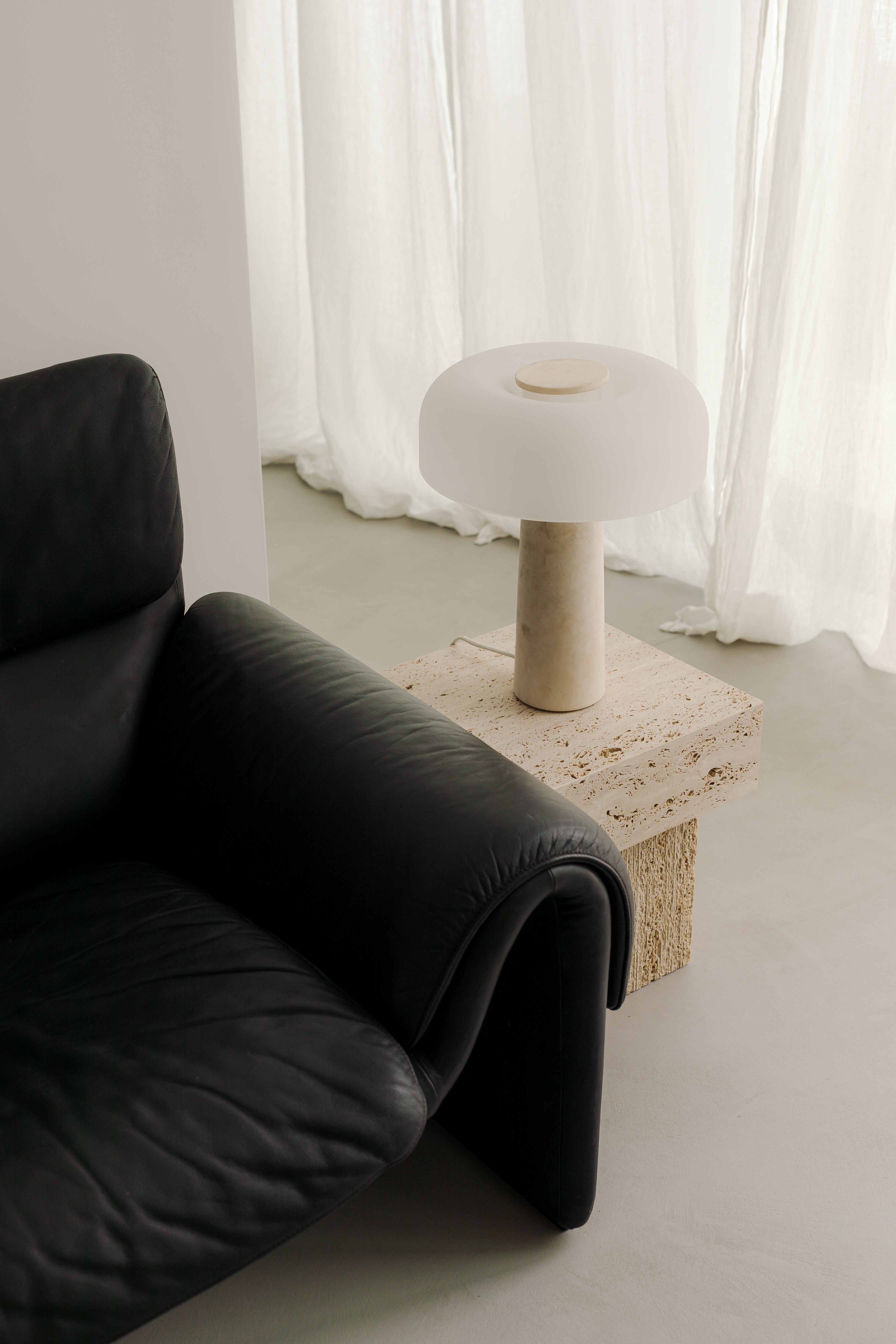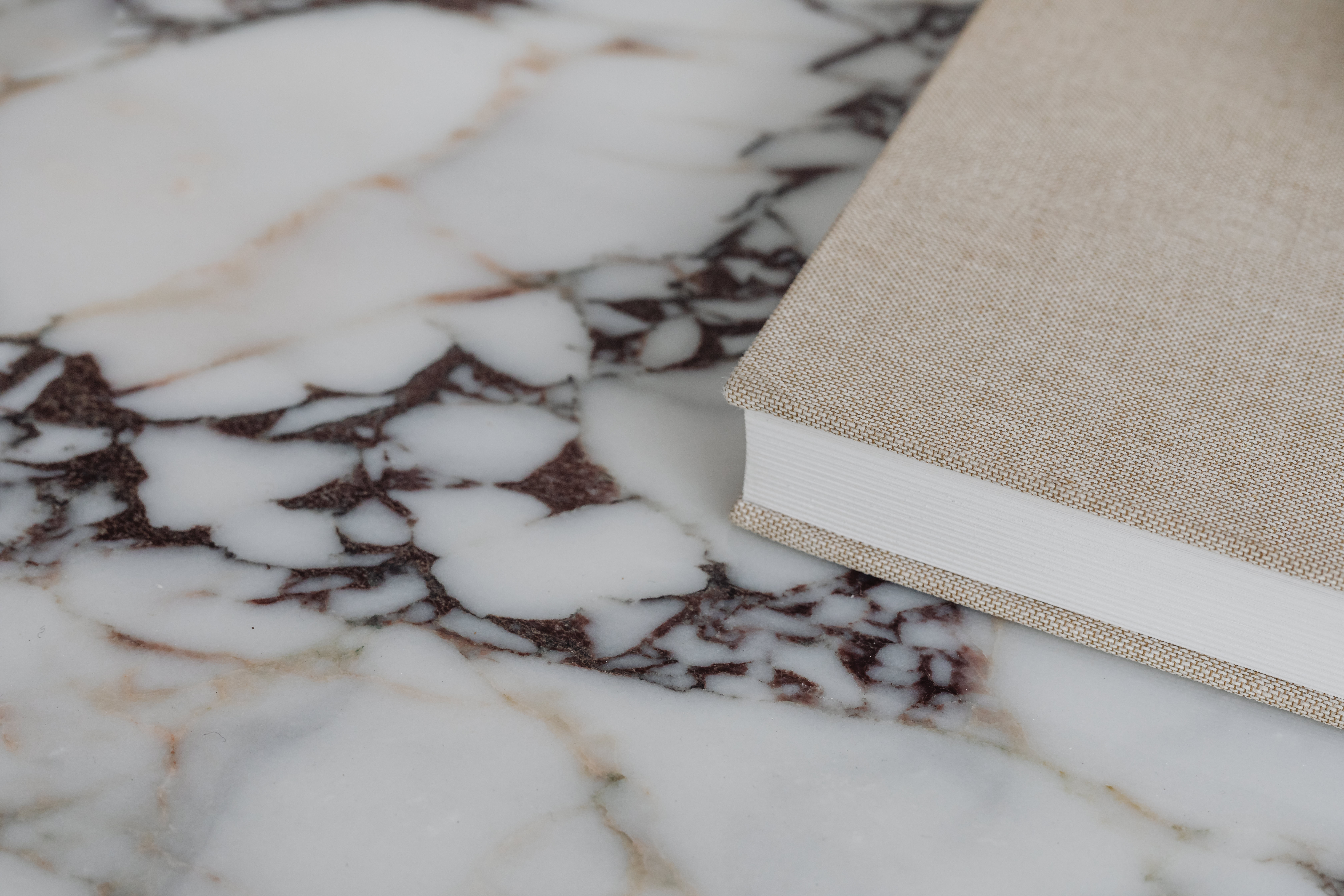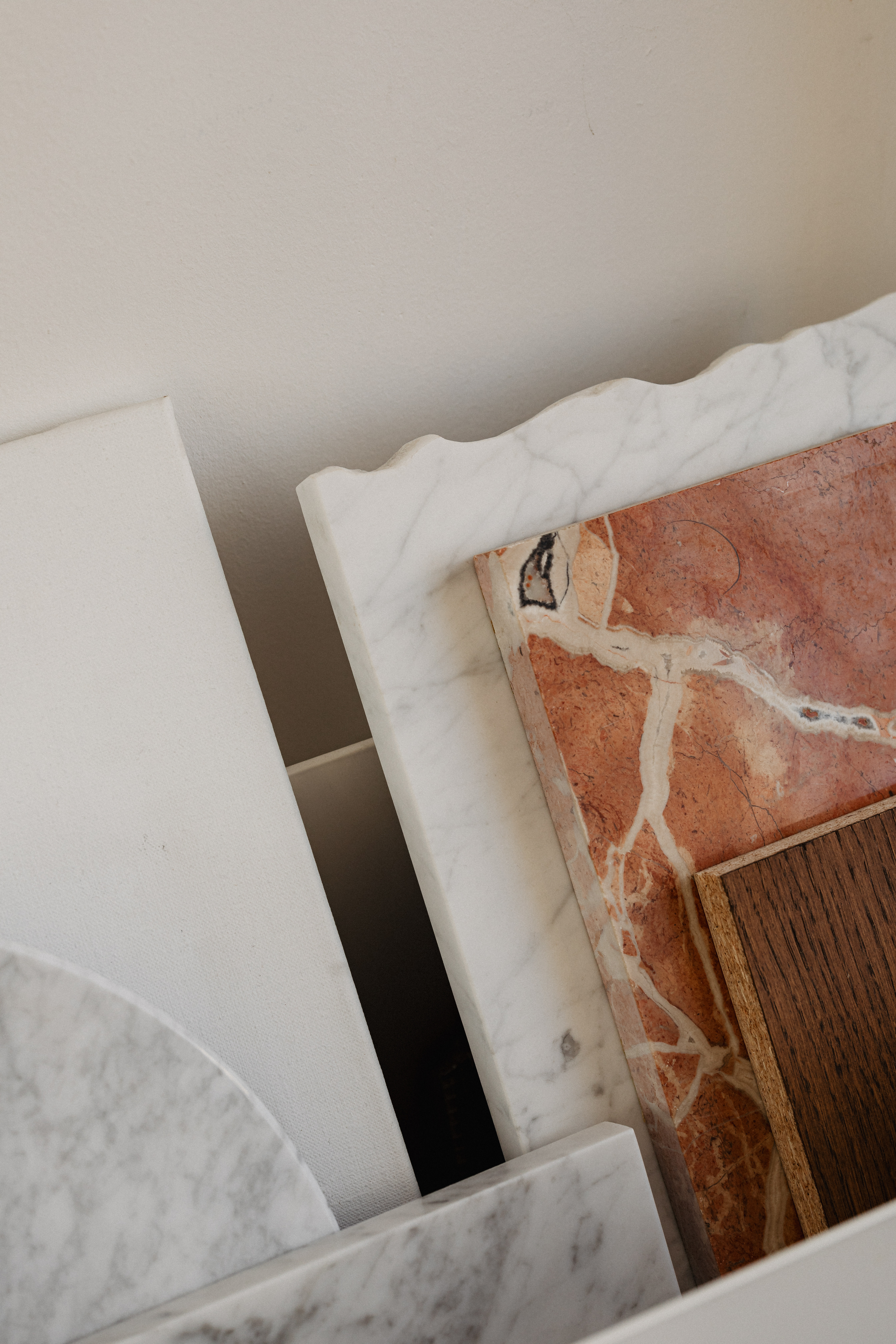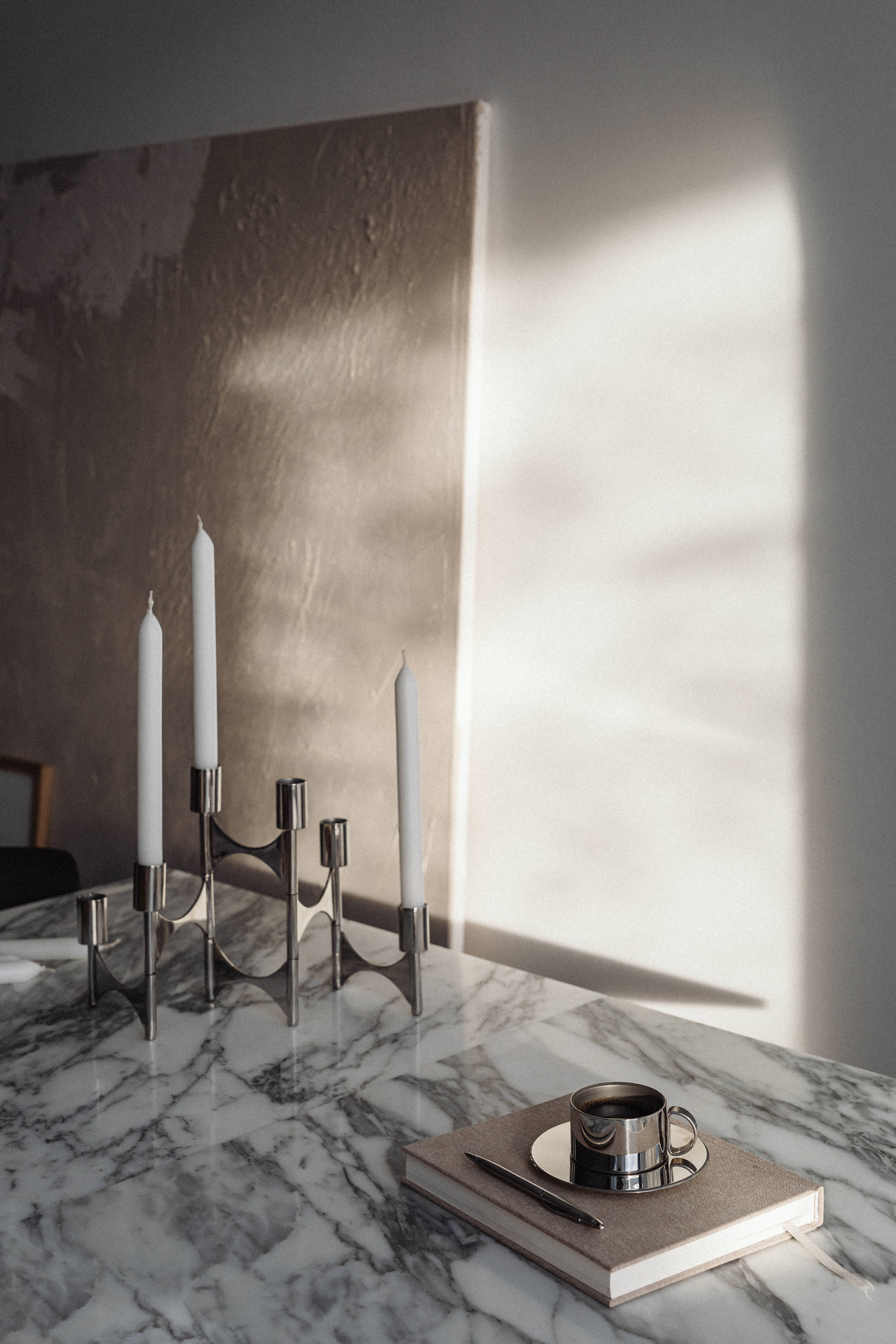
A milky ground, grey veins drifting like slow smoke. Arabescato is the most theatrical marble of Carrara, and yet the most architectural. Here is how we use it without ever letting it take all the light.
A marble born of the Apuans.
Arabescato comes from the Apuan Alps, the Tuscan massif that has fed Western sculpture since antiquity and gave Michelangelo the block for his David. It belongs to the great Carrara family: a limestone metamorphosed and crystallised by pressure and heat, its ground ranging from pure white to pearl grey. What sets it apart is the drawing.
Its name says everything. Arabesco, the arabesque: those dark veins that never run straight but coil, branch and frame paler islands. Where Calacatta traces broad golden ribbons and Statuario stays sober, arabescato composes a genuine landscape, different from one block to the next. No two slabs are ever alike.
The grammar of veining.
Choosing an arabescato means first choosing a slab, not a sample. You select the whole block at the stoneyard, follow the run of the veins, and decide what will be shown. The finest varieties — Arabescato Corchia, Vagli, Cervaiole — are distinguished by the density and nervousness of their grey network.
Then comes the decision that changes everything: the book-match. By sawing two successive slices and opening them like a book, you obtain a mirrored pattern, a butterfly symmetry that turns a worktop into a painting. It is spectacular, but it is measured to the centimetre: a botched book-match is a mistake the stone keeps for life.
As for finish, we almost always prefer honed to polished. Matt, arabescato keeps its cloud-like depth and its silken hand; mirror-polished, it grows talkative and throws back every reflection in the room. Veining needs no shine to exist.
“Arabescato is not laid. It is staged, once, in the right place.”
Why now.
After several seasons of muted minimalism, 2026 permits the strong piece again. We no longer try to flatten everything: we want a surface that speaks, a single gesture that structures a neutral room. Arabescato is exactly that accent — graphic enough to hold an entire living room, timeless enough never to date.
It also answers the appetite for truth running through today's decoration: a stone quarried and sawn, whose geological history can be read on its very surface. It imitates nothing. It is the motif.
How to use it well.
The rule is simple: one arabescato scene per room. A dining-table top, a monolithic vanity, a full-height splashback, a fireplace surround, a kitchen island treated as sculpture. The moment you multiply the surfaces, the veining begins to shout and the room loses its axis. Here, luxury is restraint: you leave a bare wall, a quiet wood and a matt textile to frame the marble so it can breathe.
On the edges, a thick, softly eased profile gives the stone its monolithic weight; a fine, sharp arris makes it more contemporary. Two characters, two houses.
Pairings that work.
- With smoked walnut: the dense, dark wood settles the eye, then the marble carries it off towards its veins — a perfect balance.
- With patinated brass: a warm, matt metal that tempers the coolness of the grey without competing with it.
- With waxed plaster or raw linen: matt, calm surfaces that leave the veining all the acoustic space of the room.
- With brushed nickel or chrome: for a cooler, more graphic stance, in the spirit of the modular candelabra of the seventies.
Pitfalls to avoid.
- Do not lay it raw as a kitchen worktop; lemon, vinegar and wine etch marble in seconds. A kitchen arabescato is honed, sealed, and its patina accepted.
- Do not saturate the room; two veined surfaces quarrel, one alone reigns.
- Do not mistake it for an "arabescato-effect" porcelain; the printed pattern repeats every metre and the eye unmasks it at once.
- Do not neglect the run of the veins at installation; a worktop joint that cuts an arabesque in two ruins all the marble-mason's work.
A stone that tells a story.
Arabescato is not a background material. It is an author's piece, chosen slab by slab, laid once and for all, that will carry the story of a house for decades. You do not buy it to fill a surface, but to give a room its single moment of theatre. Used well, it does not age: it becomes the discreet signature you notice last, and remember longest.