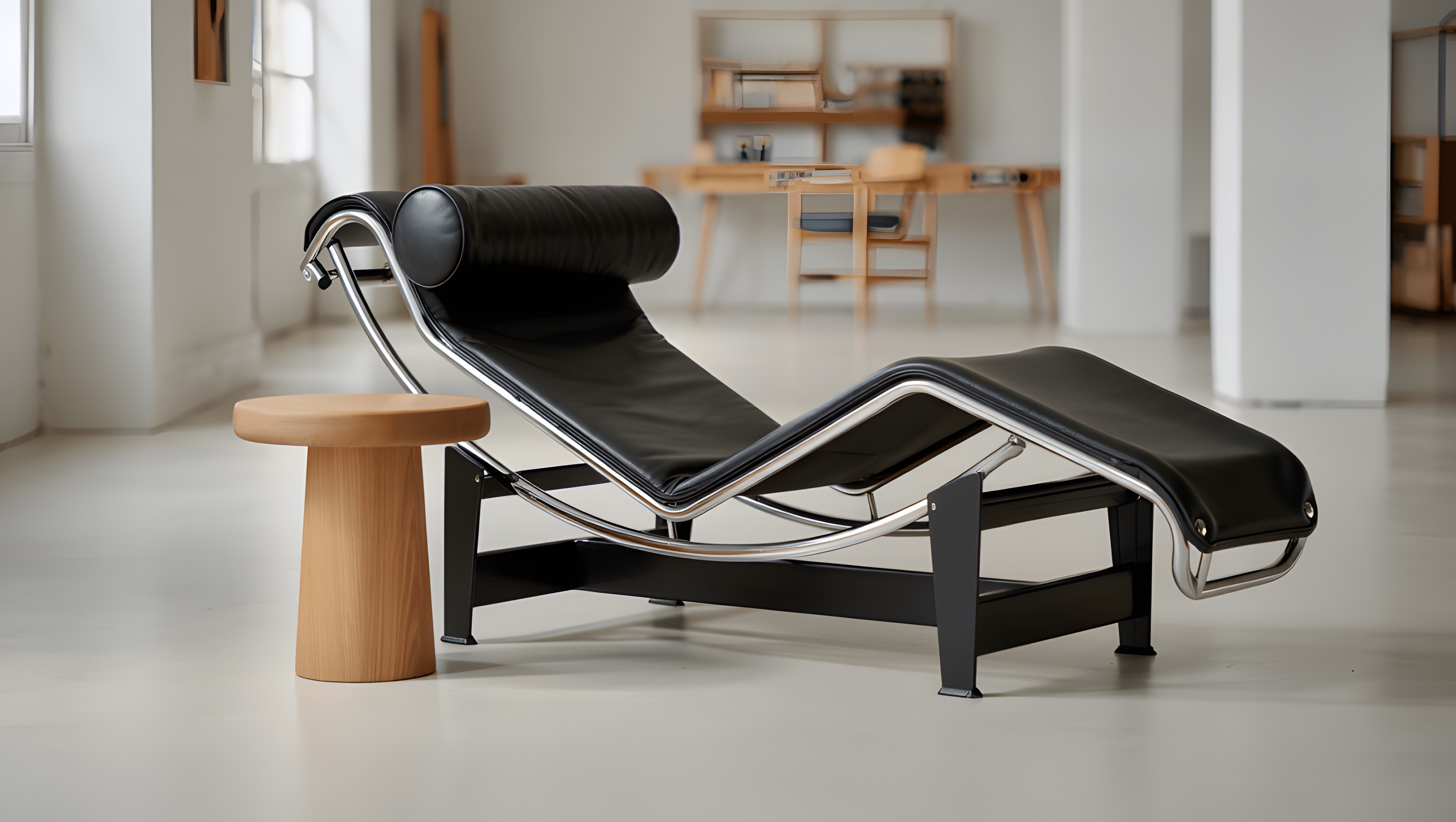
While the century celebrated the right angle, one man spent his life defending the curve, colour and joy. Jean Royère was never modern in the strict sense. Perhaps that is precisely why he never stopped being so.
A late self-taught man.
Nothing destined Jean Royère for decoration. Born in 1902 into a bourgeois family, he first worked in the timber trade, then broke with everything at twenty-nine to devote himself to a craft he had never been taught. That late start was his good fortune: no master to imitate, no school to obey. He designed by instinct, the way one writes a language of one's own invention.
By the late 1930s he opened his own studio on the Faubourg Saint-Honoré. The tone was set: Royère would not be a theorist of functionalism, but an enchanter of interiors.
War on the right angle.
Where his rationalist contemporaries hunted the pure line and the steel tube, Royère did exactly the opposite. His furniture is full, rounded, generous. He loved ball feet, wave-shaped backs, forms that seem modelled rather than built. Comfort was, for him, no concession: it was the very subject.
His palette followed the same freedom. When good taste demanded beige and black, he dared bright yellow, sea green, royal blue, powder pink. With Royère, a room need not be serious to be elegant.
"A house should smile at those who live in it."
The Polar Bear.
If only one piece were to remain, it would be this one. Created in the late 1940s, the Polar Bear (Ours Polaire) sofa is a soft mass with no visible feet, entirely upholstered in bouclé wool, its armrests as round as an animal's paws. It resembles no sofa of its time, and every coveted sofa of today.
Around it orbits a whole bestiary: the Liane wall lights and floor lamps, sinuous brass stems punctuated with spheres; the Tour Eiffel side tables in latticed wrought iron; the Œuf and Boule armchairs. An entire vocabulary, recognisable among thousands.
A decorator to the courts.
Royère's paradox is that he was snubbed by the French critics and adored by the powerful. He opened offices in Cairo, Beirut, Lima and São Paulo. He furnished the palaces of the Shah of Iran, King Farouk of Egypt, King Hussein of Jordan. His joyful, warm, colourful luxury spoke a universal language that elites the world over understood better than the Parisian purists.
In 1980, weary, he closed shop and retired to the United States, where he died the following year, all but forgotten in his own country.
The revenge of the saleroom.
History has repaid him with a flourish. From the 1990s, dealers and collectors rediscovered Royère; his authentic pieces, rare and never mass-reissued, now reach dizzying heights at auction. A period Polar Bear sofa changes hands for the price of a flat. The curve once dismissed as frivolous has become one of the safest investments in twentieth-century design.
What Royère teaches us.
You need no Polar Bear to hold on to his lesson. Royère reminds us that a successful interior is not a correct interior: it is one inhabited by an emotion. That a single curved piece, set in a well-behaved room, is enough to change its mood. That colour is not a risk but a tool. And that comfort, the word serious design long despised, may be the greatest refinement of all. It is this openly declared warmth that we try to slip into every one of our projects.